The team behind it was led by Li Shibin, an assistant researcher with the National University of Defence Technology’s College of Aerospace Science and Engineering in Changsha, Hunan.
They reported on their invention in the Journal of National University of Defence Technology this month.
“The system effectively utilises the thermal energy generated by aerodynamic heating as the driving force for the active cooling cycle, achieving autonomous pressurisation and cooling of the heat control device,” the paper said.
“It ensures the normal operation of critical components in special sections under long-duration flight conditions and meets the design objective of efficient thermal utilisation for hypersonic aircraft.”
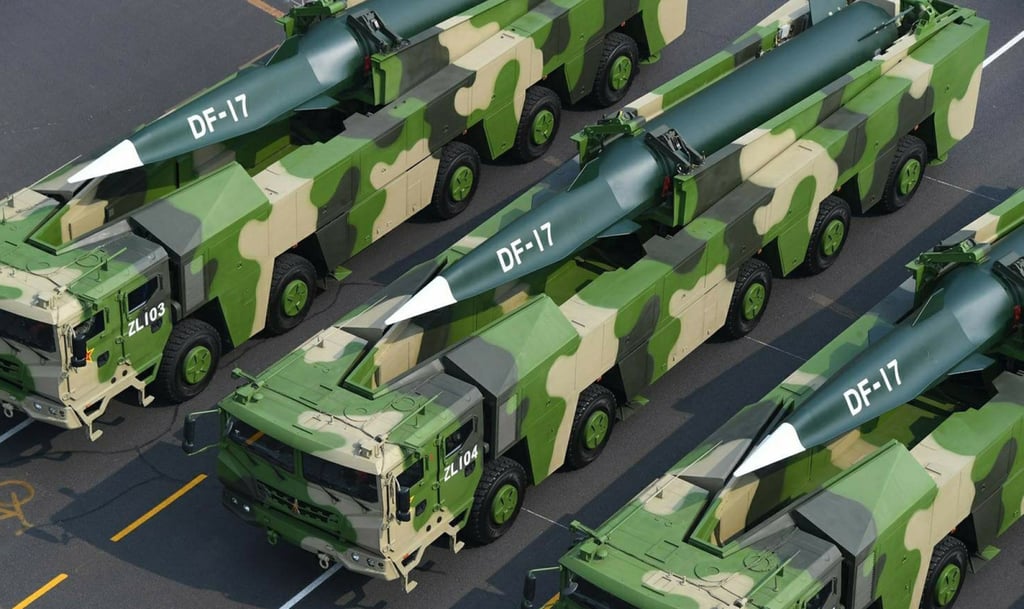
China is in a race with the United States and Russia to develop hypersonic capabilities. It has conducted test flights of long-duration, long-range hypersonic unmanned aircraft and aims for crewed global flights by 2035.
But flight duration is limited. Some estimates say the C-HGB can fly for less than half an hour, with a range of about 3,000km (1,860 miles), while China’s new hypersonic weapons can enter and exit the atmosphere multiple times, with a global range, flight time of over an hour and a top speed close to Mach 20.
“In high-speed flight environments, the heat flux density on the aircraft’s surface increases rapidly to the power of three of the flight speed,” Li and his team wrote in the paper. “Especially under long-duration conditions, the accumulation of aerodynamic heat makes thermal protection a crucial factor affecting the success or failure of the project.”
Traditional cooling approaches no longer work in these conditions. To find a solution the team said they had to “think outside the box”.
Their cylindrical cooling device was designed for the new generation of hypersonic aircraft and underwent ground tests in 2022 or earlier, according to the paper.
The bottom of the cylinder is in contact with the underside of the aircraft, where it heats up. During flight, that heat moves to the top of the cylinder, while cooling water flows clockwise inside the device, driven by the pressure produced by temperature-sensitive components. A water storage container at the top is filled with an aerogel that can absorb water.
Testing has shown that the device can control the cabin temperature to below 100 degrees Celsius (212 degrees Fahrenheit) during the first 50 minutes of flight, according to the paper. After that, the coolant starts to boil and vaporise, transferring heat at a faster speed until it reaches peak efficiency by the 66th minute.
At this point, high-temperature steam is slowly released from a pressure relief valve and the porous structure of the aerogel ensures a stable and prolonged vaporisation process. The aerogel also provides thermal insulation, keeping the cabin temperature low even after the water evaporates.
Li’s team said their device was simpler than high-temperature heat pipes that use liquid metal as a cooling medium. They also claim it would be easier to put into practice than active cooling systems driven by external forces such as devices that simulate perspiration.
“Without increasing system complexity, it can maximise the use of a cooling medium to absorb and release heat in different phases, achieving optimal temperature control,” the scientists said.
26:05
China is boldly going where no one has gone before
Since hypersonic flight requires an extensive and complex thermal management system, the new device would need to be used in conjunction with other thermal protection technologies such as high-temperature-resistant coatings and lightweight insulation structures.
The device would be suitable to cool critical areas including air rudders and important electronic equipment, according to the team.
A US congressional investigation last year found that inadequate cooling systems were the main reason the United States is lagging behind China on hypersonic weapons.
“The fundamental remaining challenge involves managing the extreme heat that hypersonic missiles are exposed to by travelling at high speeds in the atmosphere for most of their flight,” said the congressional report released in January 2023.
“Shielding hypersonic missiles’ sensitive electronics, understanding how various materials perform, and predicting aerodynamics at sustained temperatures as high as 3,000 degrees Fahrenheit require extensive flight testing,” it said. “Tests are ongoing, but failures in recent years have delayed progress.”